Article Highlights
- Successful SAFe implementation starts with an honest assessment of Agile maturity, clear business goals, and visible executive sponsorship.
- Leaders and change agents need shared Lean-Agile training and a Lean-Agile Center of Excellence to sustain adoption across the enterprise.
- Launching an Agile Release Train aligns teams to value streams, establishes Program Increment cadence, and turns the transformation strategy into coordinated delivery.
- Embedded coaching, Inspect and Adapt workshops, and post-PI retrospectives create the feedback loop required for continuous improvement and long-term scale.
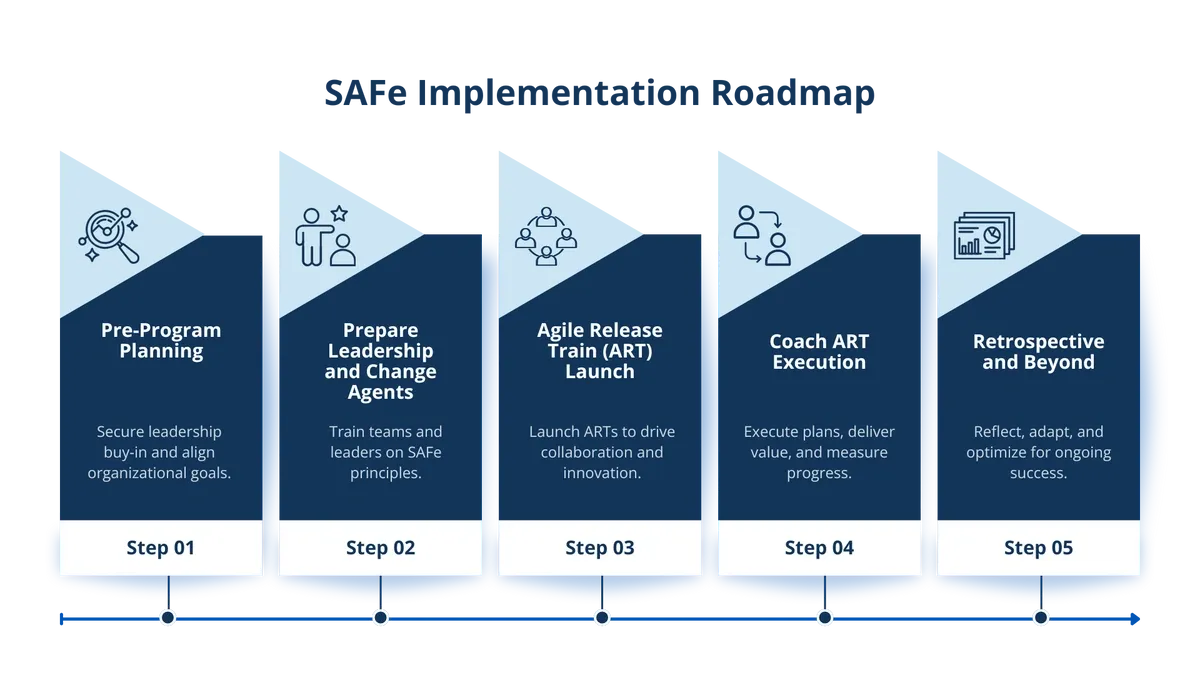
Scaling Agile across an enterprise — a true Agile Transformation — is a complex undertaking, demanding structured change, strong leadership, and a clear strategy. The Scaled Agile Framework (SAFe) provides a proven system for organizations that seek alignment, collaboration, and continuous improvement at every level. For professionals seeking career advancement, global mobility, and skill diversification, mastering these principles is essential. Learning Tree’s SAFe Implementation outlines a practical five-step roadmap, distilled from work with Fortune 500 companies, government agencies, and leading Agile teams.
Below, explore each step, illustrated by real-world examples and actionable advice designed to empower your SAFe journey and position you at the forefront of organizational change.
Step 1: Pre-Program Planning
Every successful SAFe Implementation begins with a comprehensive understanding of your organization’s current Agile maturity. This diagnostic phase lays the foundation for a customized implementation plan aligned with organizational goals. Learning Tree’s SAFe Program Consultants and customer service teams conduct individual skill assessments and an Enterprise Agile Maturity Assessment so the transformation is data-driven and targeted.
A core component in this stage is securing buy-in from business leaders and executive teams. Practitioners must frame objectives in terms of business value rather than technical achievements, understand leaders’ pain points, and present SAFe as a direct response to those challenges.
- Conduct individual skills assessments: Uncover capability gaps to tailor learning and development.
- Facilitate an Enterprise Agile Maturity Assessment: Establish a baseline for the transformation.
- Host a program kick-off event: Align ART members, business owners, and support teams around the vision, goals, roles, and value.
Get Business Buy in! Scaled Agile Framework Implementation.
Step 2: Prepare Leadership and Change Agents
Enterprise agility thrives on leaders and change agents who understand Lean-Agile principles. Targeted training, such as Leading SAFe, supports the creation of a Lean-Agile Center of Excellence (LACE). This hub coaches, mentors, and sustains momentum across the enterprise.
- Provide Leading SAFe training for business leaders.
- Use specialized SAFe for Government Training where public-sector context is required.
- Use SAFe Lean Portfolio Management Training to strengthen portfolio decision-making.
- Establish a LACE and prepare change agents to champion SAFe values across departments.
Step 3: Agile Release Train (ART) Launch
Launching the first Agile Release Train (ART) turns theory into coordinated value delivery. ARTs align teams around customer value streams and a shared Program Increment cadence. Value Stream Identification workshops, PI ceremonies, and role-based development prepare Release Train Engineers, Product Owners, Scrum Masters, and Agile Teams for execution.
Recommended courses include SAFe Scrum Master Training, SAFe Product Owner/Product Manager, and SAFe Release Train Engineer Training.
Embedded SAFe Program Consultants support teams through PI execution, key ceremonies, and Inspect and Adapt workshops. Advanced development such as SAFe Advanced Scrum Master Certification and SAFe DevOps Training can further strengthen agility and delivery pipelines.
SAFe Product Innovation: Unlocking Agile Success with Lean Practices.
Step 4: Coach ART Execution
Successfully implementing SAFe requires ongoing support, alignment, and collaboration. Customized enterprise training and embedded coaching help teams apply SAFe practices in daily workflows while encouraging continuous improvement.
- Embedded Coaching Days: Real-time support for applying SAFe principles.
- Inspect and Adapt Workshops: Structured evaluation and improvement.
- Iteration Planning and Backlog Refinement: Clear goals, priorities, and actionable work.
- Daily Stand-Ups, Reviews, and Retrospectives: Consistent communication, feedback, and learning.
- Scrum-of-Scrums: Coordination across teams working toward shared objectives.
Step 5: Retrospective and Beyond
A successful SAFe Implementation goes beyond the initial rollout. Continuous improvement, regular retrospection, and ongoing skill development keep organizations adaptable. Post-PI assessments and retrospectives connect teams around practical lessons and next steps.
Targeted learning options include SAFe for Government Micro-Credential: Roles & Responsibilities, SAFe Lean Portfolio Management Training, and SAFe Agile Product Management Training.
Common Challenges and Key Considerations
- Leadership alignment is foundational.
- Robust training and coaching build confidence and skill.
- Data-driven assessments identify requirements for transformation.
- Continuous feedback sustains momentum and responsiveness.
Your Transformation Starts Here
A successful SAFe Implementation is built step by step, empowering organizations and individuals to deliver value at scale. To accelerate your journey, explore the Scaled Agile Framework and connect with Learning Tree’s expert coaches.
Frequently Asked Questions (FAQs)
What are the five steps for implementing SAFe successfully?
The roadmap covers pre-program planning, preparing leadership and change agents, launching an Agile Release Train, coaching ART execution, and using retrospectives to improve and expand. Each stage builds the alignment, skills, operating cadence, and feedback loops needed to support enterprise agility.
Why is leadership alignment important in a SAFe implementation?
Leadership alignment connects the transformation to business priorities, secures executive support, and helps teams understand the value they are expected to deliver. Leaders also model Lean-Agile behaviors, support investment decisions, and remove organizational barriers that can slow adoption.
What is an Agile Release Train in SAFe?
An Agile Release Train, or ART, is a long-lived team of Agile teams aligned to a shared value stream. The ART works on a common cadence, plans together through Program Increments, and coordinates delivery so multiple teams can create value consistently.
How can organizations sustain SAFe after the first Program Increment?
Organizations can sustain SAFe by continuing coaching, measuring skills and maturity, facilitating Inspect and Adapt workshops, refining backlogs and planning practices, and investing in targeted role-based training. Regular retrospectives help teams turn delivery experience into measurable improvements.